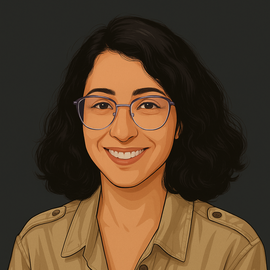
Ashena (Atena) Gorgan Mohammadi
PhD Student in Computational Neuroscience
Zenke Lab
Friedrich Miescher Institute for Biomedical Research
University of Basel
Biography
I am a PhD student in Computational Neuroscience at the lab of Friedemann Zenke at the Friedrich Miescher Institute, where I am working on understanding the computational principles of predictive learning in the brain. Specifically, I am interested in how the brain learns to predict the future from a stream of sensory stimuli through time and how cortical circuits can implement such predictive learning.
I completed my MSc in Computer Science at the University of Tehran under the supervision of Mohammad Ganjtabesh, where I studied the computational models of Theory of Mind and developed a simple spiking model of imitative reinforcement learning. During my master’s, I also collaborated in a project on self-supervised representation learning for online handwriting applications.
Before that, I received my BSc in Computer Science from the University of Tehran, where I worked on a project on developing an accelerated python framework for spiking neural networks.
Interests
- Self-Supervised Representation Learning
- Predictive Processing
- Spiking Neural Networks
- Computational Neuroscience
Education
PhD in Computational Neuroscience, 2023--present
Friedrich Miescher Institute for Biomedical Research and University of Basel, Switzerland
MSc in Computer Science, 2019--2021
University of Tehran, Iran
BSc in Computer Science, 2015--2019
University of Tehran, Iran
Skills
Python
C++
Java
Database
SQL, Oracle, MySQL
Git
Machine Learning
Scikit-learn, numpy, pandas, scipy
Deep Learning
PyTorch
Visualizations
Matplotlib, Seaborn, Plotly
Spiking Neural Networks
BindsNET, ANNarchy, PymoNNto
Experience
PhD Student
Friedrich Miescher Institute for Biomedical Research and University of Basel
Chief Teaching Assistant
University of Tehran
Chief Teaching Assistant
University of Tehran
Teaching Assistant
University of Tehran
Chief Teaching Assistant
University of Tehran
Teaching Assistant
University of Tehran
Teaching Assistant
University of Tehran
Teaching Assistant
University of Tehran
Teaching Assistant
University of Tehran
Android Developer
Accomplishments
NeuroAI: Neuroscience and AI
Theoretical & Computational Neuroscience Summer School (CNeuro2022)
1st Symposium of Computational and Mathematical Psychology: Deep Learning & Neural Networks
Two-day Symposium on Computational Neuroscience (From Biology to AI)
Featured Publications
Understanding neural circuit principles for representation learning through joint-embedding predictive architectures
Tracking prey or recognizing a lurking predator is as crucial for survival as anticipating their actions. To guide behavior, the brain must extract information about object identities and their dynamics from entangled sensory inputs. How it accomplishes this feat remains an open question. Classical predictive coding theories propose that this ability arises by comparing predicted sensory signals with actual inputs and reducing the associated prediction errors. While such models capture important aspects of cortical computation, they typically focus on faithfully predicting sensory input and do not explicitly address how abstract, untangled representations of objects and their dynamics emerge solely through experience. Here, we develop a theory of representation learning in neural circuits that shifts the focus from prediction in the input space to prediction in representation space, without relying on external supervision or labeled data. Specifically, we introduce recurrent predictive learning (RPL), a recurrent joint-embedding predictive architecture inspired by self-supervised machine learning, that learns abstract representations of object identity and their dynamics and predicts future object motion from continuous sensory streams. Crucially, the model learns sequence representations that resemble successor-like representations observed in the primary visual cortex of humans. The model also develops abstract sequence representations comparable to those reported in the macaque prefrontal cortex. Finally, we outline how RPL’s modular feedforward-recurrent organization could map onto cortical microcircuits. Our work establishes a circuit-centric theory framework that provides new perspectives on how the brain may acquire an internal model of the world through experience.
Recent Publications
Projects
Recent & Upcoming Talks
Recent Posts
Contact
- Basel, Basel-Stadt
- DM Me